
The Development of a Hero of the Biosphere
Gilberto Cintrón Molero:
The Development of a Hero of the Biosphere
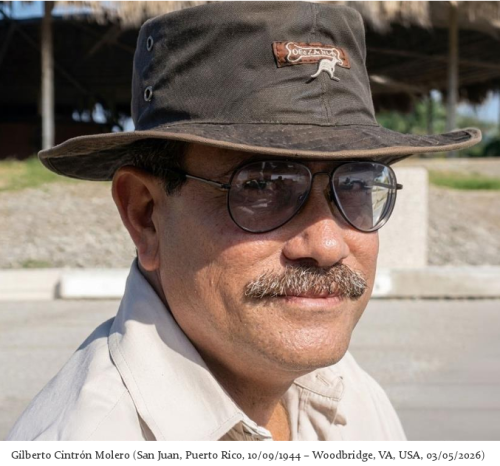
by Yara Schaeffer-Novelli and Ariel E. Lugo
Early life (1950-1960)
Gilberto was a boy attentive to the stories of his maternal grandfather, Don Antonio Molero, a proud Spanish citizen living on a Caribbean island recently “taken over” by the United States of America. He would recount, under the watchful eye of his grandson, his reminiscences of an exciting life, with travels and business in Cuba, and incredible experiences in Ceuta, a Mediterranean city under Spanish rule. In short, a true enchanted world for someone whose limitless mind was being shaped by a keen curiosity.
That boy became a young man – of few words it is true – inclined to experimentation in the world of science where, both at school and in the garage at home (his laboratory), he continued expanding his knowledge and curiosity of natural phenomena. Still in school, he participated in a writing contest whose prize would be a trip to Cuba to visit the U.S. Naval Base, Guantanamo Bay, including a visit to a submarine!
WOW – and off the teenager Gilberto Cintrón Molero went on his first of many more underwater adventures.
During the holidays, the teenager worked at an uncle’s gas station and, a little later, took advantage of the time with bolder ventures, traveling as a ship’s boy on small vessels that traded between other islands near Puerto Rico. It was then that he got to know St. Thomas, St. John, and St. Croix, saving money to pay for college.
Young Adult (1960-1970)
At the University of Puerto Rico, marine sciences kept that young man committed to his coursework and to participating as an assistant in projects coordinated by professors from the United States, such as El Verde Rain Forest Radiation Experiment under the responsibility of Dr. Howard T. Odum. The story of his meeting Odum is legendary. One sunny weekend, Gilberto left his home in San Juan and headed to the Luquillo Mountains, where he intended to measure water quality parameters in a tropical stream. Serendipitously, H.T. Odum passed by and jumped into the water with Gilberto, asking him what he was doing. Thereafter, Gilberto was offered a job as part of the project sponsored by the US Atomic Energy Commission. He always recounted that he stood night watch in a little house on the top of the mountain, taking care of the equipment. His scientific contribution was based on a class project on vertebrates, where he counted frogs and examined their stomachs to determine niche partitioning. He also studied the variation in the size and frequency of stomata with elevation in the Luquillo Mointains. Not long ago, he recounted that he participated in the first measurements of CO2 concentration in the atmosphere as part of a study of the metabolism of a rain forest.
In those years, due to the Cold War, he had the opportunity to participate as an aquanaut of PRINUL – Puerto Rico International Undersea Laboratory (1971-1976), on the island of St. John. These were life experiences in an underwater habitat, where each participant had a mission of about 15 days living in the “La Chalupa” habitat, performing research activities on coral reefs, among other tasks that kept them busy from 8 to 10 hours daily, simulating the daily life of submerged living.
Professional Career (1970-2026)
Gilberto also took the time to take a marine geology course at Woods Hole, Massachusetts, that qualified him for work as commander of large vessels and a radio communication technician in the US Coast Guard, where he also taught courses in astronomy and navigation. Gilberto always kept a powerful ham radio in his home in San Juan, and he routinely communicated with people from all over the world, particularly during clear night sky conditions, but also in special situations – such as when hurricane Hugo struck the island of Puerto Rico on September 18, 1989.
As a marine biologist, he developed his master’s research on phytoplankton bioluminescence (chemiluminescence) in Jobos Bay, Puerto Rico. Fascinated by the marine realm, he acquired extensive experience with ecological studies on coral reefs; his main studies were developed at La Parguera and Fajardo, Puerto Rico, and at St. John, United States Virgin Islands.
Mangrove ecological studies occupied a special chapter in his life, with projects throughout the Caribbean and Latin America. Mangroves research methodologies, dealing with structural and functional characterization, were among Cintrón’s main interests early in his studies of mangroves. This was reflected in many publications, including the 1984 UNESCO volume, The Mangrove Ecosystem: Research Methods, edited by Snedaker, S.C. and Snedaker, J.G. In this publication, Gilberto developed one of his many ideas about the structure of mangrove forests. You can infer forest function from precise measures of forest structure that took advantage of the allometric relations of organisms. Gilberto’s chapter in this book is a must read for anyone studying the structure of mangroves anywhere in the world.
With a master’s in marine sciences, life was heading towards a doctorate in Australia. However, the tentacles of the Vietnam War reached the young scientist, and he was drafted for military service. A change of course made him focus on learning combat techniques, very different from those related to the phenomena and processes that govern life.
It was a little over two years of life which were not entirely wasted since, upon identifying his intellectual qualities and his training in Biological Sciences, he was assigned to work in one of the laboratories at Walter Reed Hospital in Washington, D.C. He participated in the creation of vaccines to protect military dogs trained to detect traps and landmines, as they were becoming victims of a tropical disease responsible for the death of those invaluable animals. Another activity that involved his incredible skills was the construction of equipment for urine analysis of soldiers authorized to return to the United States. Gilberto traveled twice to an American base in the “theater of military operations” as the person in charge of operating the equipment and as the samples’ custodian.
Returning to Puerto Rico, it was not easy to resume his work to provide for his family. After working as a technician for the Environmental Quality Board of the Government of Puerto Rico, he worked for more than 15 years at the Department of Natural Resources of Puerto Rico as Director of the Oceanography Program until 1992. During that time, he commanded the research vessel Jean A, developing marine biology and geology projects of interest to the government of the Commonwealth of Puerto Rico.
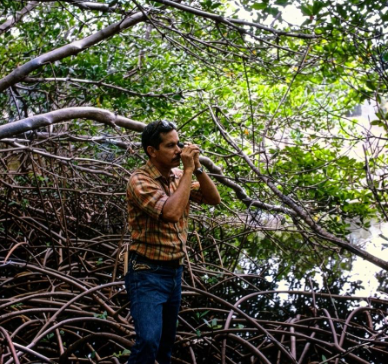
Gil using a hand-refractometer in a fringe mangrove environment.
Three accomplishments of Gilberto and colleagues during this time in his career merit attention. Gilberto led a crew of colleagues in studies of the humid mangroves of the north coast of Puerto Rico. The results of these studies were reported in an international mangrove symposium held in Hawaii at the East-West Center. That symposium in 1974, marked the historical moment when a younger cadre of mangrove ecologists participated with the senior giants of the field and basically revolutionized the mangrove research agenda from one focused on descriptive natural history to the emerging quantitative ecosystem studies of mangroves and associated coastal ecological systems.
A second accomplishment of Gilberto was the systematic study of arid mangroves that are typical of the south coast of Puerto Rico stretching from Mona Island to the municipal islands of Vieques and Culebra. Armed with a portable refractometer (see photo) and a surveyor’s level, Gilberto led systematic expeditions to as many mangroves stands as were available and conducted transects through the mangroves integrating topography, hydrology, and mangrove structure. The results, published in Biotropica in 1978, is a classic in the mangrove literature.
Finally, when the Zoe Colocotronis ran aground on the south coast of Puerto Rico spilling oil and killing mangroves at Cabo Rojo (1973), the Puerto Rico government decided to sue the vessel for damages to the environment. Given his work on arid mangroves, Gilberto was called to be an expert witness in the court case, which resulted with an unprecedented victory for the environment. For the first time, a federal court recognized the environment as having a legal standing to receive compensation for the damages caused by the oil spill.
International Affairs (1992-2015)
Gilberto was a strong conservationist who believed and promoted the precautionary principle. He extended his conservation views from the insular realm, in which he grew up, to the international realm in 1992, when a new chapter in his life began. In Arlington, VA, he worked as a specialist at the International Affairs Division in the Fish and Wildlife Service of the U.S. Department of the Interior, where he coordinated the International Program with the countries of the Western Hemisphere and served as a United States’ Focal Point to the Ramsar Convention. He worked for the federal government of the United States until his retirement in 2015.
Brazil Studies (1978–2026)
His Brazilian mangrove studies began in 1978, when he first visited to São Paulo as an invited lecturer for a one-week course on mangrove ecosystems, V Simpósio Latinoamericano de Oceanografia Biológica, offered by the Instituto Oceanográfico da Universidade de São Paulo and the ALICMAR (Asociación Latinoamericana de Ciencias del Mar).
Once that short course was finished, Gil rushed to participate in a mangrove seminar organized by UNESCO in Cali, Colombia, focused on the scientific aspects of the mangrove ecosystem and the human effects upon it in Latin America and the Caribbean. This is one of several mangrove courses that Gilberto participated, including one in Venezuela in 1996 (see photo). When the seminar in Cali concluded, participants stated the necessity of giving “strong support for cooperative efforts among countries with mangrove areas in the region.” That message has been spread to the world by Gil’s words in a UNESCO report that resonates to this day.
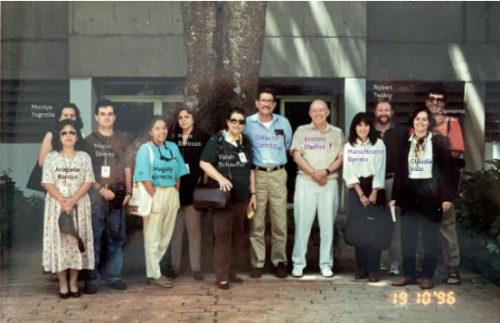
Participants of mangrove course in Venezuela (1996).
Rushing once more, he returned to São Paulo, where the oceanographers Yara Schaeffer Novelli and Raquel Rothleder Adaime were waiting to take Gilberto to visit the mangroves of Cananéia on the southern coast of São Paulo (see photo). There, the trio used the Oceanographic Institute’s facilities and a small, motorized canoe to explore the estuaries, searching for suitable sites to start the first Brazilian project studying mangroves as a functional ecosystem. All his experience working in Brazilian mangroves, literally from north to south, culminated in 2023 edition Brazilian Mangroves and Salt Marshes, by Springer Nature in collaboration with Dr. Guilherme Abuchahla.
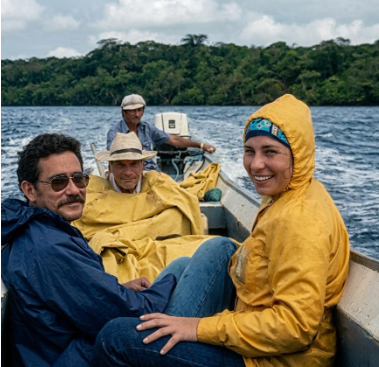
The Brazilian chapter at the very beginning, in 1978.
Hero of the Biosphere
Since the 1970’s until his last days, Gilberto shared his knowledge with everybody and without setting limits. His generosity, earnestness, words of wisdom, responsibility, academic method, and friendship made him a true Renaissance man. He set the example of how to use the basic concepts of ecology for conservation, inspiring young scientists and professionals through his interactions and partnerships. This was more evident with BIOMA (Laboratory of Mangrove Bioecology) of the Oceanographic Institute of the University of São Paulo, Brazil. From 2006 onwards, Gilberto was affiliated with the Instituto BiomaBrasil as his functional institution, embedding his polymathy into the work and with everyone who crossed his path.
Gilberto leaves behind a legacy as an enlightened mentor and a true legend, now taking his place among the Encantados – the sacred entities of Northern Brazilian lore who dwell within and protect the mangroves, forever watching over the nature he so deeply understood.
How Gilberto acquired this knowledge about mangroves describes his development as a hero of the biosphere. He started his journey studying stream pools, plant stomata and tree frogs in the Luquillo Mountains. He then studied Puerto Rican mangrove stands in detail in the context of local climate and coastal conditions. When confronted with the mangroves of Brazil the scope of his analysis ballooned. He wrote: “We must shift management from single steady state, small-scale domain thinking to broad cross-scale thinking for resilience and transformability management.”
Gilberto quickly realized that mangroves are geo-ecological multiscale systems of planetary importance. These planetary systems occur on landscapes at the edge of chaos where order and disorder processes coexist. Cyclic succession in mangroves is a response to the chaos, which mangroves transform into order. He called them “engineering ecosystems”. Also, mangroves in Brazil have the advantage of atmospheric-tropospheric rivers that influence their distribution and allow their self-organization, which reinforces their resilience and persistence. No one before Gilberto had visualized mangroves so comprehensively while maintaining a global view for their conservation. This is why we designate him a hero of the biosphere.
———————————————————————————————–
Bibliography
Cintrón, G. 1970. Variation in size and frequency of stomata with altitude in the Luquillo Mountains. Pages H-133-H-135 in H.T. Odum and R.F. Pigeon (eds.), A tropical rain forest. National Technical Information Service. Springfield, VA.
Cintrón, G. 1970. Niche separation of tree frogs in the Luquillo Mountains. Pages E-51-E-53 in H.T. Odum and R.F. Pigeon (eds.). A tropical rain forest National Technical Information Service. Springfield, VA.
Cintrón, G., A.E. Lugo, D.J. Pool and G. Morris. 1978. Mangroves of arid environments in Puerto Rico and adjacent islands. Biotropica 10:110–121.
Cintrón-Molero, G. and Y. S. Schaeffer-Novelli. 1983. Introducción a la ecología del manglar. UNESCO Regional Office for Science and Technology for Latin America and the Caribbean (Uruguay). 109 p.
Cintrón, G. and Y. Schaeffer-Novelli. 1984. Methods for studying mangrove structure. Pages 91-113 in S.C. Snedaker and J.G. Snedaker (eds.). The mangrove ecosystem: research methods. UNESCO, Paris, France. 251 p.
Cintrón-Molero, G. and Y. Schaeffer Noveli. 2019. Tying mangrove distribution in Brazil to atmospheric-tropospheric rivers. International Journal of Hydrology. 19:92–94.
Cintrón-Molero, G. and Y. Schaeffer-Novelli. 2019. The role of atmospheric-tropospheric rivers in partitioning coastal habitats and limiting the poleward expansion of mangroves along the southeast coast of Brazil. International Journal of Hydrology 3(2): 92-94.
Cintrón-Molero, G., Y. Schaeffer-Novelli, A.S. Rovai, C. Coelho-Jr, C., R.P. Menghini, R. Almeida, C.C. Vale, E. Bernini, G.M.O. Abuchahla, and M. Cunha-Lignon. 2023. Variability of Mangroves Along the Brazilian Coast: Revisiting. Pages 43-65 in: Y. Schaeffer-Novelli, G.M.O. Abuchahla and G.Cintrón-Molero (eds) Brazilian Mangroves and Salt Marshes. Brazilian Marine Biodiversity, Springer Nature.
Cintron-Molero, G., Y. Schaeffer-Novelli, A.S. Rovai and G.M.O. Abuchahla. 2023. The mangrove-salt marsh complex: a dynamic landscape approach. Pages 365-380 in: Y. Schaeffer-Novelli, G.M.O. Abuchahla and G. Cintrón-Molero (eds) Brazilian Mangroves and Salt Marshes. Brazilian Marine Biodiversity, Springer Nature.
Cintron-Molero, G., Schaeffer-Novelli, Y., Abuchahla, G.M.O. and Rovai, A.S. 2023. Coastal zone adaptive management in the context of complex adaptive systems. Pages 381-392 in: Y. Schaeffer-Novelli, G.M.O. Abuchahla and G. Cintrón-Molero, G. (eds) Brazilian Mangroves and Salt Marshes. Brazilian Marine Biodiversity, Springer Nature.
Odum, H. T., A. Lugo, G. Cintrón and C.F. Jordan. 1970. Metabolism and evapotranspiration of some rain forest plants and soil. Pages I-103-I-164 in H.T. Odum and R.F. Pigeon (eds.). A tropical rain forest. National Technical Information Service: Springfield, VA.
Schaeffer-Novelli, Y. and G. Cintrón-Molero. 1999. Brazilian mangroves: a historical ecology. Ciencia e Cultura (Sao Paulo) 51(3-4): 274-286.
Schaeffer-Novelli, Y. and G. Cintrón-Molero. 2018. Water as a geoecologic product and ultimate shared resource: towards sustainability. International Journal of Hydrology 2(1): 68-70.
Schaeffer-Novelli, Y., G. Cintron-Molero, R.R. Adaime and T.M. Camargo. 1990. Variability of mangroves along the Brazilian coast. Estuaries 13(2):204-2018
Schaeffer-Novelli, Y., H.S.L. Mesquita and G. Cintrón-Molero. 1990. The Cananéia lagoon estuarine system, Sao Paulo, Brazil. Estuaries 13(2):193-203.
Schaeffer-Novelli, Y., G. Cintrón-Molero, M.L.G. Soares and M.M. Tognella-de-Rosa. 2000. Brazilian mangroves. Aquatic Ecosystem Health and Management 3 (4):561-570.
Schaeffer-Novelli, Y., G. Cintrón-Molero and M.L.G. Soares. 2002. Mangroves as indicators of sea level change in the muddy coasts of the world. Pages 245-262 in: Healy T., Wang Y, Healy J-A (eds) Muddy coasts of the world: processes, deposits and function, Elsevier Science, Amsterdam.
Schaeffer-Novelli, Y., G. Cintrón-Molero, M. Cunha-Lignon and C.Coelho-Jr. 2005. A conceptual hierarchical framework for marine coastal management and conservation: a “Janu-Like” approach. Journal of Coastal Research 42:191-197.
Schaeffer-Novelli, Y., G. Cintrón-Molero, J. Primavera and A. Quarto. 2005. The mega tsunami of 26 December 2004: recognizing ecological lessons from a large-scale natural disaster. Indian Ocean Tsunami Fish 2(1):31-38.
Schaeffer-Novelli, Y., G. Cintrón-Molero, A.S. Reis-Neto, G.M.O. Abuchahla, L.C.P. Neta and C.F. Lira. 2018. The mangroves of Araçá Bay through time: An interdisciplinary approach for conservation of spatial diversity at large scale. Ocean & Coastal Management 164:60-67.
Schaeffer-Novelli, Y., C. Coelho-Jr., R. Almeida, G.V. Menezes, R.P. Menghini, M. Cunha-Lignon, A.S. Rovai, A.S. Reis-Neto and G. Cintrón-Molero. 2025. Manguezais na Ilha do Cardoso, Cananéia, Estado de São Paulo, Brasil: uma narrativa histórica. Hoehnea 52: e262024.
Rovai, A.S., C. Coelho-Jr, R. Almeida, M. Cunha-Lignon, R.P. Menghini, R.R. Twilley, G. Cintrón-Molero and Y. Schaeffer-Novelli. 2021. Ecosystem-level carbon stocks and sequestration rates in mangroves in the Cananéia-Iguape lagoon estuarine system, southeastern Brazil. Forest Ecology and Management 479:118553